- Mark Sisson's Untethered
- Posts
- Interesting Links 5
Interesting Links 5
What I've been reading and thinking about

Mark Sisson
December 11, 2025
Music and mortality. Interesting study out of Australia recently found that older adults who listened to music lived longer. This was totally observational, of course. It wasn’t a controlled trial and doesn’t tell us anything definitive about causation. However, you do see that the more involved a person is with music, the better the outcomes. For instance, those who listened to music “all the time” had greater longefvity than those who listened “sometimes.” Those who played an instrument were even better off, and those who played “all the time” lived the longest. There was also an interaction with education level. Among those with the most education, the relationship between music listening and longevity was even stronger. That could be a function of what type of music they are listening to, which in my opinion could point toward an actual effect rather than just a spurious link.
Music improves immunity (for most). This next music study shows why you need to be cautious when interpreting things. They took 19 senior citizens living in an elderly home and measured their natural killer cells beforehand. Then they did a 12 week program of listening to music and playing instruments. After the 12 weeks researchers measured their natural killer cell activity again.
Overall, things got better. Natural killer cell activity, which is very important for fighting off cancer and infectious diseases, improved on average. They were better off. They were more robust. But when you break it down by the individual data points for each participant, not everyone benefited. Three people saw their natural killer cell activity and function get worse after the music program, while a few more had very little change. The rest all improved.
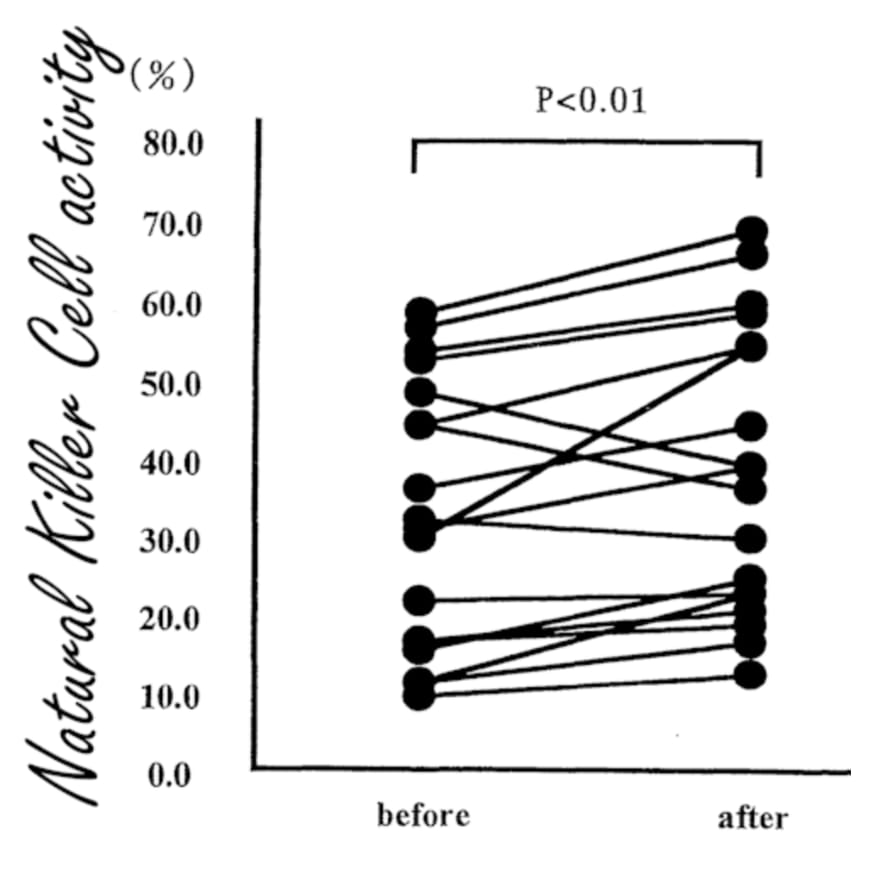
That is why I always stress the importance of looking at individual data points when determining what might be possible. Even in a study of 30,000 people where you find a definite effect in the data and you might be able to say that on average the intervention improved health by 20 percent, within that 30,000 person cohort you will find hundreds, maybe even thousands of individuals who did not benefit and who may have been harmed by (or at least alongside) the intervention.
Always be aware of that. Just because an authoritative sounding influencer or paper says something has an effect across a population does not mean it negates your personal experience with the intervention.
Magnesium and sleep. Magnesium supplementation is one of those cliches people trot out, and we people who have been in the health game a long time tend to get sick of it because everybody talks about magnesium. We know. And yet, it is important. It does work. This latest study took chronically poor sleepers and gave them magnesium bisglycinate before bed amounting to 250 mg of elemental magnesium (with around 1.5 grams of glycine, hence the “glcyinate”). They went from legitimate insomnia to just “mild” sleep disturbance by day 14. By day 28, they had improved even more. So it is an easy thing to try if you are having trouble sleeping or even if you are not, because as the story goes, and as you have heard thousands of times already, magnesium is involved in more than “389 physiological processes and reactions” in the body and “nobody gets enough from food” these days. You may be sick of hearing about magnesium, but that doesn’t mean it isn’t important.
Adding “AI skills” to your resume doesn’t give you a leg up. New study finds that applicants who indicated they had strong AI skills on their resumes didn’t get any advantage in the call-back process. My take? The real advantage is in having “cloaked” AI skills. People are using it, and using it effectively, but not telling anyone about it. Silent AI competence is more valuable than broadcasted AI competence.
Is “early onset cancer” really spiking? A new analysis finds that most “early onset” cases are really just overdiagnoses.
Ashkenazi Jews are more Italian than Levantine. A new, closer look at their ancestry finds that most Jews are actually closer to ancient Romans than ancient Israelites.
Singapore’s founder’s crowning achievement? Air conditioning. Controlling ambient temperature in tropical heat and humidity allowed Singaporeans to focus on indoor knowledge work and take advantage of their inborn talents, turning a small island with few natural resources into one of the most productive nations on Earth.
Inspiratory breathing exercise warmups beat traditional warmups for subsequent 400 m sprint performance. Before a race, 400 m runners either did only a traditional 15 minute jogging warmup or the jogging plus an inspiratory warmup consisting of two sets of 30 reps of breathing through a restricted airflow device. This was the device, and here’s how it works. You put a noseclip on and try to inhale through the device using your mouth. They tested both 40% and 60% pressure; both pressures improved performance over the jogging alone by 0.23 seconds and 0.38 seconds respectively.
Creatine is still safe for the kidney. Although creatine does result in a small increase in creatinine levels, GFR is unaffected, suggesting that kidney function is preserved. Dose away.
Excessive vigorous exercise impairs cognitive function. I suspect the impairment is transient, as longer trials find that intense exercise improves cognitive function over time. But if you never give yourself enough time in between training sessions…
Reply